If you are evaluating land in North Beach Miami, it is easy to focus on price per square foot and miss what really drives value. In this part of Miami Beach, developers are not just buying a parcel. They are stepping into a highly managed redevelopment area shaped by zoning, design review, resiliency planning, parking constraints, and public process. Understanding those moving parts can help you see why some sites attract serious developer interest while others struggle to pencil. Let’s dive in.
North Beach Is a Planned Redevelopment Area
North Beach is not a blank-slate land play. The North Beach Community Redevelopment Agency covers 326.4 acres bounded by 87th Terrace, the Atlantic Ocean, 65th Street, and Rue Notre Dame, and the city has tied the area’s future to transportation, infrastructure, resiliency, affordable and workforce housing, and economic revitalization.
That matters because developers are underwriting more than dirt and construction costs. They are also evaluating how a site fits into a district shaped by public investment, neighborhood planning, and community priorities. In practical terms, a site that aligns with the city’s redevelopment goals may have a clearer path to marketability and long-term value.
North Beach also sits within a broader planning framework. Miami Beach states that its Comprehensive Plan and commission-approved master plans guide land use, which means site analysis should be viewed through both the zoning code and the city’s long-range policy documents.
Zoning Drives the First Pass
For most developers, zoning is where the analysis starts. In North Beach, the TC-1, TC-2, TC-3, and TC-3(c) Town Center districts are intended to support a compact, pedestrian-oriented environment with mixed uses, employment, residential components, office uses, and neighborhood-serving commercial activity.
That wording tells you something important. The city is not just allowing density. It is signaling the type of place it wants North Beach Town Center to become. So when developers study a site, they are asking whether the parcel can support that vision in a financially realistic way.
A parcel with favorable zoning but weak frontage, poor circulation, or difficult design constraints may still underperform. On the other hand, a site that fits the district’s mixed-use and pedestrian goals can have stronger appeal because it aligns with the city’s stated direction.
Height and FAR Are Not Simple Assumptions
One of the biggest mistakes in site evaluation is assuming that theoretical buildout equals realistic buildout. In Miami Beach, entitlement risk can change the economics quickly.
In January 2024, the city raised the approval threshold to exceed maximum FAR from 5 of 7 commission votes to 6 of 7, with an added impact-assessment requirement. That makes approvals more demanding and puts more weight on timing, political support, and project messaging.
For you as a buyer, seller, or investor, this means a site with a compelling concept is not automatically a low-risk site. The path to extra bulk or intensity may be narrower than it appears in a quick desktop review.
Assemblage Can Add Real Value
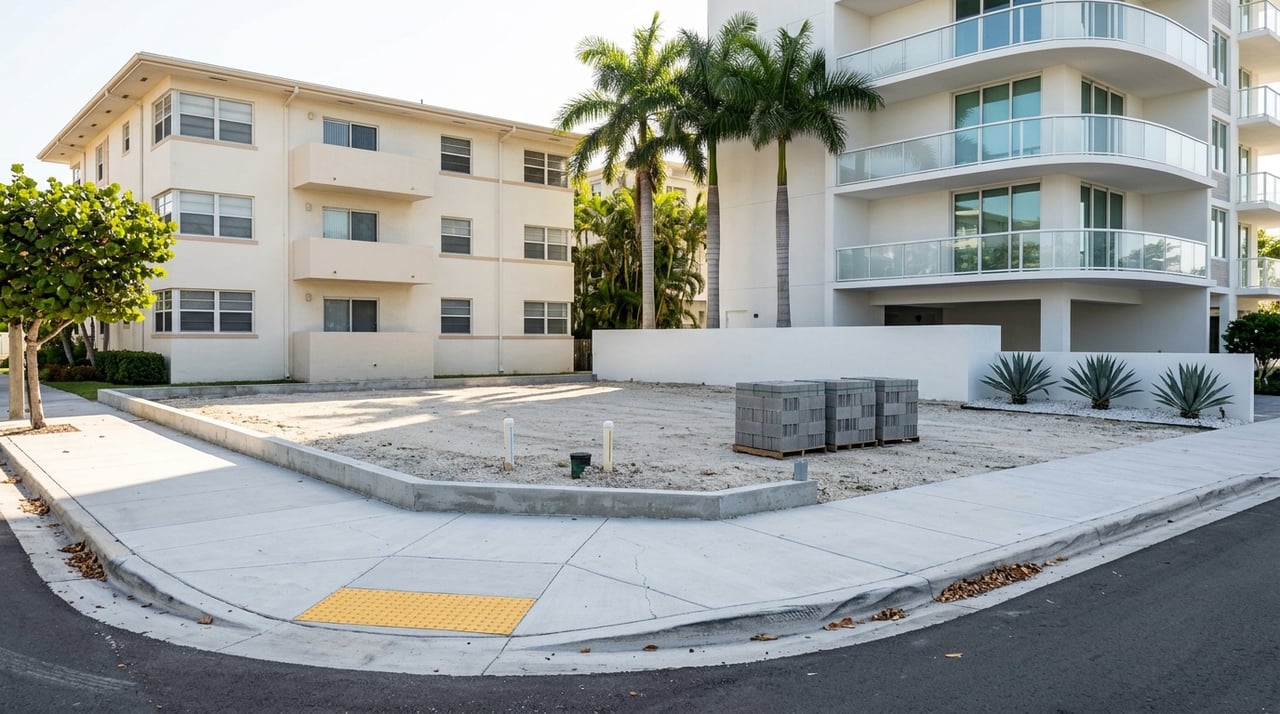
In North Beach, lot assembly is often part of the value story. A 2016 city ordinance memo discussing the Town Center districts noted support for additional height on lots or unified development sites abutting 72nd Street, and it explicitly stated that the city wanted owners to assemble and redevelop comprehensively rather than in a piecemeal way.
That is a meaningful signal for anyone analyzing land. A single parcel may be useful, but a site that can be combined with neighboring property may create a much stronger redevelopment opportunity.
Developers often look for assemblage because it can improve:
- Building efficiency
- Parking layout and circulation
- Ground-floor activation
- Design flexibility
- Overall project identity
If you own property in a strategic stretch of North Beach, neighboring parcels may affect your site’s value almost as much as your own lot dimensions do.
Design Review and Preservation Matter
North Beach development is not just a zoning exercise. Design review is part of the approval stack, and that can materially affect a project’s feasibility.
Miami Beach’s Design Review Board resources include North Beach Town Center Design Review Standards for the TC districts. The city also identifies National Register districts and historic designation reports in areas such as North Shore, Normandy Isles, and Harding Townsite South Altos del Mar.
For developers, this means massing, façade treatment, and compatibility with surrounding context can influence what gets approved. A site with limited preservation friction may be easier to move through review, while a site near protected or historically significant areas may require a more careful design strategy.
Parking Can Change the Yield
Parking is one of the least glamorous parts of site selection, but in North Beach it can be one of the most important. Miami Beach’s parking code places TC-1 and TC-2, along with nearby North Beach blocks, in parking district no. 4.
Why does that matter? Because garage form, ingress and egress, and overall parking supply can all affect how much usable product a site can actually support. On constrained urban parcels, parking is often where promising concepts run into real-world limits.
When developers compare sites, they are not just asking how much can be built. They are asking how efficiently cars, services, loading, and people can move through the property without compromising the end product.
Public Realm and Beach Access Matter More Here
North Beach has a physical advantage that inland submarkets do not. The surrounding public realm, beach access, and walkable amenities can be central to the development story.
Miami Beach’s Beachwalk is a nine-mile, ADA-accessible oceanfront promenade running from South Pointe Park to 87th Street. North Beach Oceanside Park spans nearly 28 acres from 87th to 79th Streets, and Ocean Terrace Park at 73rd Street and Collins Avenue includes beach access.
For a developer, those features are not just quality-of-life perks. They support branding, pricing, and absorption. A site with stronger ties to the public realm can offer a more compelling lifestyle and place-making narrative than an isolated parcel with weaker frontage or fewer pedestrian connections.
Resiliency Is Now a Core Underwriting Issue
In coastal Miami Beach, resiliency is no longer a side conversation. It is part of the financial model.
The city adopted a Sea Level Rise Adaptation Plan in July 2025, and in 2024 it updated the stormwater master plan and prioritized $95 million across 20 projects over the next decade. That points to continued focus on drainage, flood mitigation, infrastructure coordination, and long-term adaptation.
For developers, that usually translates into closer attention to:
- Elevation strategy
- Flood-resistant design
- Drainage and stormwater coordination
- Utility planning
- Long-term operating resilience
A site may look attractive at first glance, but if resiliency costs are high or engineering constraints are difficult, the deal can change quickly.
Alternate Approval Paths May Exist
Some North Beach sites may also be evaluated through alternate statutory frameworks. Miami Beach’s planning page lists approved Live Local Act applications, including 1960 Normandy Drive in North Beach.
That does not mean every parcel will qualify or achieve the same result. Still, it shows that developers are likely screening certain sites for more than one path forward. When a parcel fits program rules, optionality can increase buyer interest and improve negotiations.
Politics and Process Affect Exit Strategy
In North Beach, entitlement and exit strategy are closely linked. The North Beach CRA can help implement redevelopment priorities through tax increment funding, but it does not control zoning, and projects still remain subject to city zoning and historic preservation laws.
The process is also highly public. CRA governance runs through the Mayor and City Commission, and formal meetings occur under Sunshine Law requirements. That means developers must think carefully about community messaging, timing, and how a proposal fits the city’s larger goals.
In many cases, the strongest exit is tied to a project that feels consistent with North Beach’s public vision. A site that supports walkability, active ground floors, resilience, and a cohesive neighborhood story may be easier to market to capital partners and end buyers alike.
Ocean Terrace Shows the Pattern
Miami Beach’s Ocean Terrace Overlay regulations offer a useful example of how the city approaches North Beach. The overlay is designed to stimulate revitalization, encourage parcel assembly, improve the pedestrian environment, and maintain scale and character.
For certain large lots fronting both Collins Avenue and Ocean Terrace, the code allows substantial height, while also requiring active ground-floor uses and restricting formula commercial uses in key areas. That pattern reflects a broader city approach: selective, site-specific incentives tied to a defined place-making vision rather than blanket upzoning.
What the Strongest Sites Usually Have
While every parcel is different, the most attractive North Beach opportunities often combine several qualities at once. They fit the zoning framework, support good urban design, and make sense within the city’s public investment strategy.
In plain terms, developers usually pay the most attention to sites with:
- Favorable Town Center zoning
- Assemblage potential
- Manageable parking and circulation
- Limited preservation complications
- Realistic resilience costs
- Strong frontage and walkability
- A credible mixed-use, residential, or hospitality story
That combination can improve both feasibility and exit potential. In a market like North Beach, the sites that stand out are rarely just large. They are the ones that fit both the code and the city’s evolving identity.
Why This Matters for Owners and Investors
If you own land in North Beach, understanding how developers evaluate sites can help you position your property more effectively. The conversation is often bigger than lot size and price. Buyers may be valuing assemblage potential, entitlement complexity, design flexibility, and how your parcel connects to the public realm.
If you are looking to acquire a site, this same framework can help you avoid expensive assumptions. The best opportunities often come from understanding what can realistically be approved, built, parked, financed, and ultimately sold.
That is where experienced, local guidance matters. Coltrane Miami Group brings development-oriented market knowledge, senior-level advisory, and deep familiarity with complex coastal real estate across Miami Beach and nearby submarkets. If you are evaluating a North Beach site, selling land, or exploring redevelopment strategy, the team can help you assess the opportunity with clarity and discretion.
FAQs
What do developers look for in North Beach Miami sites first?
- Developers usually start with zoning, allowable use, height and FAR potential, parking constraints, assemblage possibilities, and the likely entitlement path.
Why is zoning in North Beach Miami so site-specific?
- North Beach includes Town Center districts, design review standards, preservation considerations, and public-policy goals that can make one parcel far more developable than another nearby site.
Does the North Beach CRA approve development projects?
- No. The North Beach CRA helps implement redevelopment priorities, but projects still must comply with Miami Beach zoning and historic preservation requirements.
Why does assemblage matter for North Beach development sites?
- Assemblage can improve building efficiency, circulation, parking layout, and design flexibility, which may make a site more attractive for comprehensive redevelopment.
How does resiliency affect North Beach Miami land value?
- Resiliency can affect costs tied to elevation, drainage, flood mitigation, utilities, and long-term building performance, all of which can change a project’s feasibility.
Are beach access and walkability important for North Beach sites?
- Yes. Proximity to the Beachwalk, parks, and pedestrian-friendly public spaces can strengthen a site’s branding, market appeal, and potential exit story.